
Quick Answer: To rank higher on Shopee search, fix the listings that already get impressions first. Start with keyword relevance, product title clarity, cover image CTR, complete attributes, price and voucher visibility, review quality, stock, shipping reliability, and conversion. Then check Seller Centre data every 7 to 14 days.
If your Shopee products get impressions but few clicks, your problem is not only ranking. It is the full search loop: buyers must find the listing, understand it quickly, click it, trust it, and buy. This guide shows SEA sellers how to improve Shopee search performance without relying on keyword stuffing or unsupported algorithm tricks.
Use it as a 30-minute audit for your top 20 listings in Singapore, Malaysia, Philippines, Thailand, or Indonesia. The goal is simple: improve the signals a seller can actually control before spending more on ads.
Rank Higher on Shopee Search: The Search Loop to Fix First
Shopee has not published a simple public formula for organic search ranking. Treat any exact weight, hidden score, or guaranteed ranking promise as unverified unless it comes from Shopee documentation. A safer way to work is to audit practical signals that affect how buyers and marketplace systems read your listing.
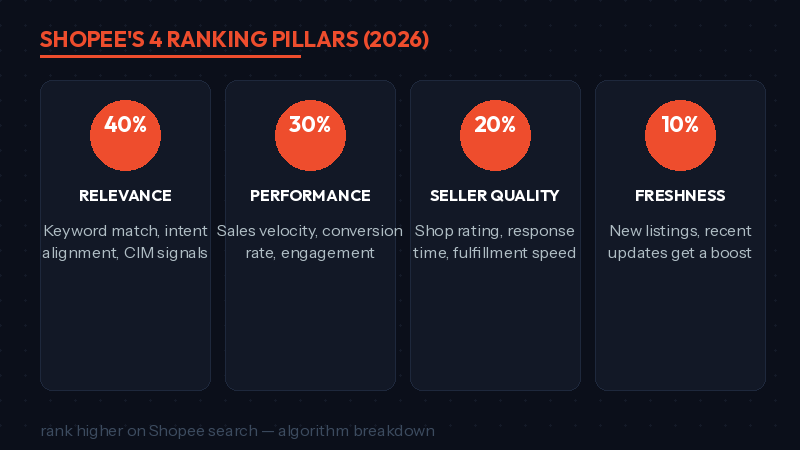
| Signal to audit | What it means for your store | First fix |
|---|---|---|
| Relevance | Your title, category, attributes, and description match the buyer search. | Put the main product phrase early and fill category attributes. |
| CTR | Buyers choose your listing from search results. | Improve cover image, price clarity, voucher visibility, and title readability. |
| Conversion | Clicks turn into carts and orders. | Remove buyer doubts with specs, variations, shipping notes, and reviews. |
| Seller trust | Your shop looks reliable enough to buy from. | Protect response time, fulfilment, stock accuracy, and rating quality. |
Why Shopee Impressions Do Not Become Clicks
A listing can appear in search and still lose the buyer in one second. The common reasons are simple: the title is hard to scan, the image does not show the product clearly, the price looks weaker than nearby listings, or the buyer cannot see the right variation, voucher, rating, or shipping promise.
Before rewriting every listing, sort your products by impressions. Pick the 20 products with visibility but weak clicks or weak conversion. Those products have the fastest upside because Shopee is already showing them to buyers.
12 Practical Fixes for Shopee Search Visibility
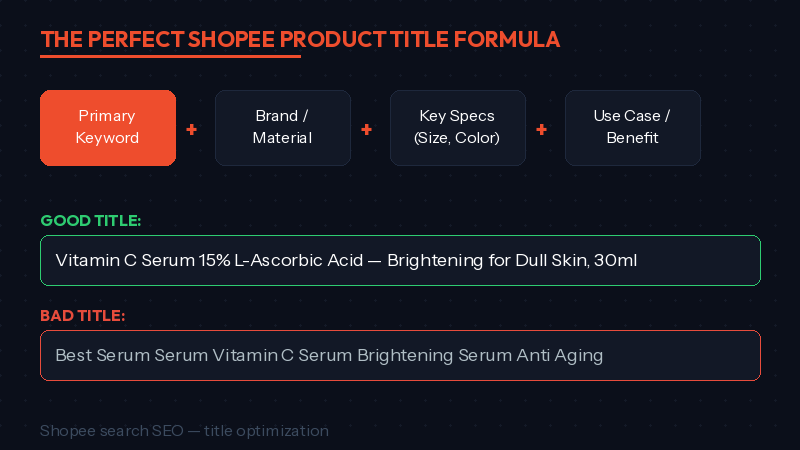
1. Put the buyer’s main phrase near the start
Use the phrase a buyer would type, not your internal SKU name. A clear title such as “Women’s Linen Shirt Long Sleeve White” is easier to understand than a title packed with repeated words, symbols, or vague claims.
2. Remove keyword and brand spam
Shopee policy documents warn against irrelevant keywords, brand spam, misleading prices, duplicate listings, and attribute spam. Keep only terms that accurately describe the product. This protects both search visibility and account health.
3. Fill every useful product attribute
Attributes help buyers filter and compare. Fill brand, material, model, size, color, warranty, origin, skin type, voltage, compatibility, or any category-specific field that applies. Do not add a fake value just to complete a field.
4. Use the right category before rewriting copy
If the product sits in the wrong category, the title and description can still miss the right buyers. Check category placement first, especially for beauty, electronics, fashion, baby products, and home goods where attributes differ by category.
5. Make the cover image win the search result
Your cover image must show the product, variation, and key use case clearly on mobile. Avoid cluttered banners, tiny text, or backgrounds that make the product hard to inspect. For a deeper image workflow, use the Canva AI Shopee product photos guide.
6. Make price, voucher, and bundle value obvious
Many buyers compare listings by total value, not headline price alone. Check whether vouchers, bundles, shipping thresholds, and campaign discounts are visible enough to support the click.
7. Rewrite descriptions for buyer questions
A good description answers what the product is, who it fits, what is included, how to choose the right variation, and what the buyer should know before checkout. Use the write Shopee product description with AI guide if you need a prompt workflow.
8. Protect review quality before scaling traffic
More traffic does not help if reviews, rating, or buyer questions show unresolved doubts. For products with low ratings, fix the product page, variation clarity, packaging, and after-sales replies before pushing more ads.
9. Keep stock and variation availability clean
Out-of-stock variations, confusing sizes, and unavailable colors weaken buyer trust. Check top listings before major campaign periods such as 9.9, 11.11, payday sales, and year-end sales.
10. Use ads to test, not to hide weak listings
Shopee Ads can help test demand and generate early data, but ads should not be used to cover unclear titles, weak images, or missing attributes. If CTR is poor in ads and organic search, fix the listing first. For ad setup, start with the Shopee Brand Max AI Ads guide.
11. Check search data on a fixed schedule
Review impressions, clicks, conversion, and keyword clues on a weekly or biweekly schedule. Do not rewrite titles every day. Give changes enough time to collect data, then update the weakest part of the listing.
12. Build internal store consistency
Listings in the same store should use consistent title patterns, photo style, variation naming, size charts, warranty notes, and shipping language. Consistency helps buyers compare products and reduces avoidable questions.
30-Minute Shopee Search Audit
Use this checklist on your top 20 visible listings. You do not need a full SEO project to make progress. You need a repeatable review that removes the obvious friction first.
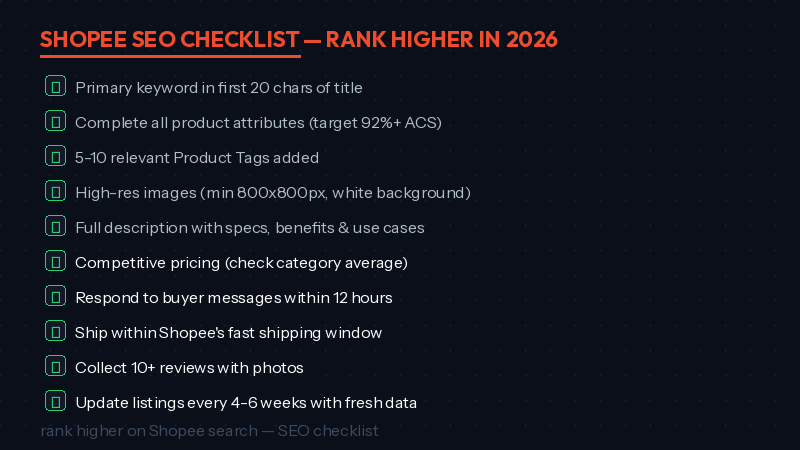
- Export or list your top 20 products by impressions.
- Mark products with weak clicks, weak conversion, or rising impressions but no sales.
- Check the first 60 characters of the title for the buyer’s main phrase.
- Check the cover image beside three competing listings.
- Fill missing attributes that are factual and useful.
- Rewrite one weak description section using buyer questions.
- Check price, voucher, stock, shipping, and review signals.
- Record the change date and review results after 7 to 14 days.
What Not to Do
- Do not repeat the same keyword or brand name just to fill space.
- Do not copy a competitor title if the specs, model, or package are different.
- Do not use misleading prices, fake scarcity, or inaccurate attributes.
- Do not create duplicate listings for the same product unless there is a clear policy-safe reason.
- Do not trust any tool or article that promises exact Shopee ranking weights without a source.
For source checks, review Shopee’s own listing and violation guidance when editing sensitive products. The Shopee listing violations guide explains keyword, brand, price, and duplicate-listing risks, while the Shopee Mall listing guidelines show why accurate attributes matter.
Where AI Fits in the Workflow
AI is useful after you know what needs fixing. It can draft clearer descriptions, compare title options, summarize reviews, and turn specs into buyer benefits. It should not invent claims, fake certifications, or unsupported keyword data.
If you use AI, keep a human checklist beside it: title accuracy, attribute accuracy, warranty wording, local spelling, prohibited claims, and whether the output matches the actual product. For tool options, start with the best free AI tools for Shopee sellers guide.
Frequently Asked Questions
How long does it take to rank higher on Shopee search?
Most sellers should give listing changes at least 7 to 14 days before judging results. Campaign timing, stock, price, reviews, and competition can all affect the result, so track the change date and compare impressions, clicks, and orders together.
Should I put more keywords in my Shopee title?
Only add keywords that accurately describe the product. A shorter, clearer title usually beats a title filled with repeated words, irrelevant brands, or symbols. The buyer must understand the item quickly.
Can Shopee Ads improve organic search ranking?
Ads can help you collect traffic and sales data, but they do not fix a weak listing by themselves. Use ads to test demand after the title, image, attributes, price, and description are already clear.
What should I fix first if I have no time?
Fix the listings with impressions but weak clicks. Start with title readability and cover image quality, then check price, vouchers, reviews, stock, and missing attributes.
Can AI help me rank higher on Shopee search?
AI can help you write clearer titles, descriptions, FAQs, and buyer benefit sections. It should support relevance and readability, not replace source checking or product accuracy.
Next Step
To rank higher on Shopee search, do not start with a new tool or a bigger ad budget. Start with the products Shopee already shows to buyers. Improve the search result, answer buyer doubts, and then use data to decide what to change next.
Useful next guides: Shopee keyword relevance ranking factor, Shopee product title optimization tips, how to improve Shopee listing CTR, write Shopee product description with AI, and Shopee Product AI Optimiser.
Quick check: Before you add another tool or increase ad spend, run the free Shopee Listing Audit. It checks title, description, image, attribute, stock, and ad-readiness basics in a few minutes.
💬 Join the Discussion
Got a question or seller tip? Drop a comment below.