Running Amazon PPC campaigns manually in 2026 is like bringing a calculator to a data science competition. With millions of bid adjustments needed daily across your campaigns, Amazon PPC AI optimization is no longer optional for serious sellers. AI tools now analyze your search term reports, adjust bids hourly, and harvest high-converting keywords while you sleep. The result? Sellers using AI-powered PPC management typically see a 25-40% drop in ACoS and significantly higher ROAS within weeks.
Quick Answer: Amazon PPC AI optimization uses machine learning to automate bid adjustments, keyword harvesting, and negative keyword management across your Sponsored Products, Brands, and Display campaigns. Tools like Perpetua, Quartile, Adtomic, and Pacvue can reduce ACoS by 25-40% and free up hours of manual campaign work each week.
Why Amazon PPC AI Optimization Matters in 2026
Amazon advertising has grown more competitive every year. Average cost-per-click keeps rising, and manual bid management simply cannot keep pace. Here is why AI optimization has become essential for your campaigns.
- Speed: AI tools monitor bids every 15-30 minutes and react to conversion data in near real-time, not based on yesterday’s metrics.
- Scale: A typical Amazon account has hundreds or thousands of keywords. No human can optimize each one daily.
- Precision: Machine learning models identify patterns in search term reports that manual analysis would miss entirely.
- Dayparting: AI adjusts bids by hour and day of the week based on when your products convert best.
Despite these advantages, an estimated 75% of Amazon sellers still manage PPC campaigns manually. That gap is your competitive edge. Sellers who adopt AI-driven bid management now can capture market share before the rest catch up.
What You Need Before You Start
Before diving into AI automation, make sure your account is ready. Jumping in too early can waste both your budget and your time.
- Active PPC campaigns: You need at least 2-4 weeks of campaign data so the AI has conversion history to learn from.
- Clear ACoS or ROAS targets: Define your target ACoS for each product or campaign group before setting up automation rules.
- Organized campaign structure: Separate your auto, broad, phrase, and exact match campaigns. AI works best with clean structures.
- Minimum ad spend: Most AI tools require at least $1,000-$2,000 per month in ad spend to have enough data for meaningful optimization.
- Amazon Advertising API access: Your Seller Central or vendor account must be connected to the tool via Amazon’s API.
How to Optimize Amazon PPC with AI Step by Step
Follow these five steps to move from manual campaign management to full AI-driven Amazon PPC AI optimization. Each step builds on the previous one.
Step 1: Audit Your Current Amazon PPC Campaigns
Start by reviewing your existing campaign performance. Download your search term reports from the last 30-60 days. Look for these red flags:
- Keywords with high spend but zero conversions (these need to become negatives).
- Search terms converting well in auto campaigns but not yet in exact match campaigns.
- Campaigns where ACoS is more than double your target.
- Products with no Sponsored Brands or Sponsored Display coverage.
This audit gives the AI tool a clean starting point. It also helps you set realistic improvement targets.
Step 2: Pick the Right AI Tool for Amazon PPC AI Optimization
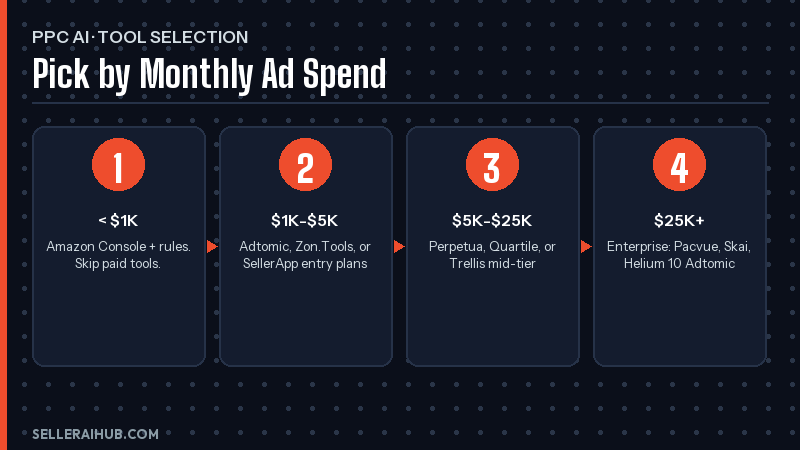
Your choice depends on your monthly ad spend, number of products, and how hands-on you want to be. Budget sellers under $5,000 per month in ad spend may start with Adtomic (included in Helium 10). Mid-range sellers spending $5,000-$30,000 per month often find Perpetua or Scale Insights a strong fit. Enterprise sellers above $30,000 per month typically benefit from Quartile or Pacvue.
We compare the top tools in detail below. For now, focus on matching your budget and campaign complexity to the right platform.
Step 3: Set Up Automated Bid Rules
Once connected, configure your AI tool with these core settings:
- Target ACoS: Set your ideal ACoS per campaign or product group. The AI will bid up or down to hit this target.
- Bid floors and ceilings: Prevent the AI from bidding too high on any single keyword. A common ceiling is 2-3x your average CPC.
- Budget pacing: Let the AI distribute your daily budget across peak hours instead of spending it all by noon.
- Placement modifiers: Allow the tool to adjust Top of Search and Product Page placement bids based on conversion rates.
Start with conservative settings. You can loosen constraints after the AI has two weeks of data under its management.
Step 4: Automate Keyword Harvesting and Negatives
This is where AI delivers its biggest advantage. Set up these automated keyword workflows:
- Keyword harvesting: The AI identifies converting search terms from auto and broad campaigns, then promotes them to exact match campaigns automatically.
- Negative keyword automation: Search terms that spend above a threshold (for example, $10-$15) with zero conversions get added as negatives.
- Match type migration: High-performing broad match terms graduate to phrase, then exact match campaigns over time.
These workflows run continuously, saving you hours of manual search term report analysis every week.
Step 5: Monitor Performance and Adjust AI Settings
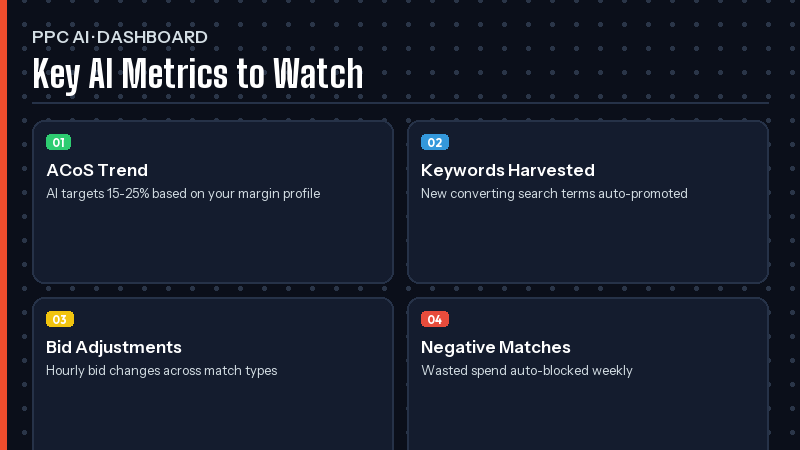
AI is not fully set-and-forget. Check your dashboard weekly for the first month, then biweekly once performance stabilizes. Watch these key metrics:
- ACoS trend: Should decrease steadily over the first 4-6 weeks.
- TACoS (Total ACoS): Measures ad spend against total revenue, including organic sales. This is your true efficiency metric.
- Impressions and CTR: If impressions drop sharply, the AI may be bidding too conservatively.
- New keyword additions: Review harvested keywords weekly to ensure quality.
Adjust your target ACoS or bid ceilings if results plateau. Most AI tools also allow you to exclude specific products or campaigns from automation if needed.
Best AI Tools for Amazon PPC Optimization
Here is a comparison of the top AI-powered Amazon PPC tools available in 2026. Pricing is approximate and may vary based on your ad spend tier.
| Tool | Starting Price | Best For | Key AI Feature | Ad Types Supported |
|---|---|---|---|---|
| Adtomic (Helium 10) | $99/mo (included in Platinum) | Budget sellers, beginners | Rule-based + AI bid suggestions | SP, SB, SD |
| Perpetua | $250/mo | Mid-range sellers ($5K-$20K spend) | Hourly bid optimization via Amazon Marketing Stream | SP, SB, SD, DSP |
| Scale Insights | $78/mo | Solo sellers wanting affordable automation | AI-powered bid automation with custom rules | SP |
| Quartile | $695/mo | Enterprise sellers ($30K+ spend) | Six patented AI algorithms with hourly adjustments | SP, SB, SD, DSP |
| Pacvue | ~$500/mo or 3% of spend | Multi-channel enterprise brands | Cross-marketplace AI with AMC integration | SP, SB, SD, DSP |
| Sellozo | $149/mo | Small to mid-size sellers | Automated bid and budget optimization | SP, SB |
SP = Sponsored Products, SB = Sponsored Brands, SD = Sponsored Display, DSP = Demand-Side Platform.
If you sell on multiple marketplaces, check out our guide to the best AI tools for Amazon sellers in 2026 for a broader comparison.
Tips for Better Amazon PPC AI Optimization Results
Getting the most from AI-driven PPC requires more than just turning on a tool. Follow these tips to maximize your return.
- Optimize your listings first. AI can drive traffic, but poor listings kill conversions. Use AI to write your Amazon product listings before scaling ad spend.
- Start with your best sellers. Let the AI learn on products with strong conversion history. Expand to newer products once you see results.
- Do not change targets too often. Give the AI at least two weeks at each ACoS target before adjusting. Frequent changes disrupt the learning cycle.
- Use Amazon’s own AI features too. Amazon Campaign Manager now includes AI-suggested bids and audience targeting. These work alongside third-party tools.
- Watch your TACoS, not just ACoS. A rising ACoS with a declining TACoS means your ads are boosting organic rank, which is a positive sign.
- Set up product-level budgets. Prevent your top spender from eating the budget meant for launching new products.
If you also sell on Shopee, our Shopee ads AI optimization guide covers similar AI strategies for that marketplace.
Amazon PPC AI Optimization FAQ
How much does Amazon PPC AI optimization cost?
Costs range from $78 per month for basic tools like Scale Insights to $695 or more per month for enterprise platforms like Quartile. Some tools charge a percentage of your ad spend (typically 2-4%) instead of a flat fee. Adtomic is included in Helium 10 plans starting at $99 per month, making it the most budget-friendly option for new sellers.
Can AI completely replace manual Amazon PPC management?
Not entirely. AI handles bid adjustments, keyword harvesting, and negative keyword management extremely well. However, you still need to set strategy, define targets, review new product launches, and make high-level budget allocation decisions. Think of AI as a tireless assistant that executes your strategy 24 hours a day.
How long before I see results from AI PPC optimization?
Most sellers see meaningful ACoS improvements within 2-4 weeks. The AI needs at least one to two weeks to gather enough data and calibrate its bidding models. Full optimization, including keyword harvesting and dayparting benefits, typically shows within 4-6 weeks.
Does Amazon PPC AI optimization work for new product launches?
AI tools work best with existing conversion data. For brand new products with no sales history, start with manual campaigns for 2-4 weeks to gather baseline data. Then switch the campaigns to AI management once you have enough conversions for the algorithm to learn from.
What is a good ACoS target for AI-managed campaigns?
It depends on your margins and goals. Most sellers target 15-25% ACoS for established products. For product launches, you might accept 30-40% ACoS to build ranking. Your AI tool should let you set different targets per campaign or product group based on your specific profit margins.
Conclusion
Amazon PPC AI optimization gives you a real edge in 2026. By automating bid management, keyword harvesting, and negative keyword workflows, you free up hours each week and reduce wasted ad spend. Start by auditing your current campaigns, pick a tool that matches your budget and ad spend level, and give the AI at least four weeks to deliver results.
The sellers winning on Amazon this year are not the ones spending the most. They are the ones letting AI make thousands of smart micro-decisions every single day. Your next step? Pick one tool from the comparison table above, connect your account, and set your first ACoS target. Your future ROAS will thank you.
💬 Join the Discussion
Got a question or seller tip? Drop a comment below.