
The Shopee keyword relevance ranking factor is the single biggest reason two near-identical listings end up on different pages of search results. If your product barely shows up for its obvious keywords, this is almost certainly where the problem sits — not your price, not your reviews, not your ad budget.
Quick Answer: The Shopee keyword relevance ranking factor measures how closely your listing’s title, attributes, tags, and description match the buyer’s search query. Shopee scores every text field, weights the title highest, and promotes listings with full, natural keyword coverage. Fix your top 20 listings first — most stores see ranking gains within 7–14 days.
What Is the Shopee Keyword Relevance Ranking Factor?
The Shopee keyword relevance ranking factor is the algorithm signal that decides whether your product is a good match for a buyer’s search query. When someone types “wireless earbuds bluetooth 5.3” into Shopee search, the algorithm scans every listing and asks one question: does this product’s text actually match what the buyer wants?
It’s one of seven core ranking factors Shopee uses (see our full guide on how to rank higher on Shopee search), but it’s the one you control most directly. Unlike seller metrics or CIM scores that take weeks to move, you can rewrite a listing today and see ranking changes within a few days.
How Shopee Measures Keyword Relevance in 2026
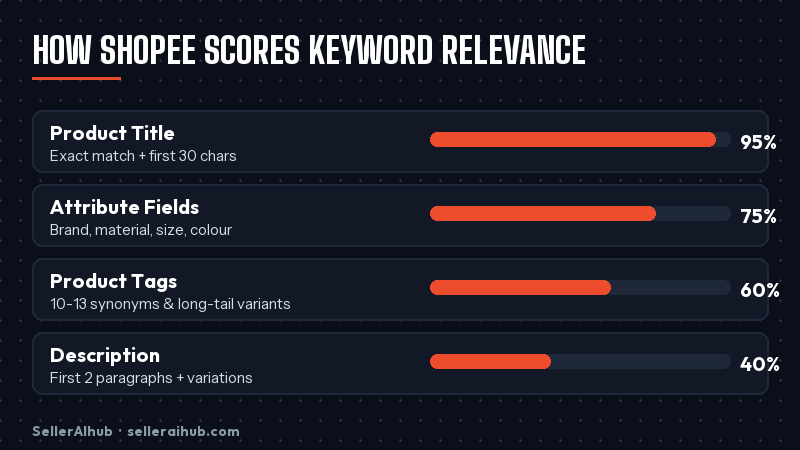
Shopee doesn’t publish its exact formula, but listing audits across SG, MY, and PH stores — plus what Shopee Seller Centre shows in the Listing Quality Score panel — point to four fields the algorithm scans, in descending weight:
| Field | Weight | What the Algorithm Looks For |
|---|---|---|
| Product Title | Highest | Exact keyword match, position (first 30 characters scored heaviest) |
| Attribute Fields | High | Brand, material, size, colour — filled completely with buyer-language values |
| Product Tags | Medium-High | 10–13 tags using synonyms and long-tail variants |
| Description & Variations | Medium | Keyword coverage in first 2 paragraphs and variation names |
Title: Where the Shopee Keyword Relevance Ranking Factor Starts
Your title is scored in two passes. First, Shopee checks for an exact match on the full buyer query. Second, it scores token overlap — how many words in the title appear in the query, weighted by position. The first 30 characters carry the most weight, which is why strong titles lead with the product type and highest-volume attributes, not the brand name.
Attributes: The Invisible Half of Keyword Relevance
Every attribute you leave blank is a keyword Shopee can’t match you on. Buyers who filter by “cotton” or “stainless steel” will never see listings where those attributes weren’t filled. In 2026, attribute completeness is no longer optional — it’s an indexing requirement for filtered search.
Tags: Catching Long-Tail Queries
Product tags capture the buyer phrases your title can’t fit. If your title says “Waterproof Bluetooth Earbuds”, your tags should cover “wireless earbuds”, “sports earbuds”, “sweatproof earbuds”, “IPX7”, and any brand synonyms. Use all 13 slots — empty tags are wasted relevance.
Description & Variations: The Last 20%
Shopee scans the first two description paragraphs for keyword coverage. Variation names (“Black / Size M”) also count. Rewrite variations from generic codes like “Option 1” into keyword-rich labels like “Black — 500ml Bottle” to squeeze extra relevance signal from fields most sellers ignore.
7 Ways to Improve Your Shopee Keyword Relevance Ranking Factor
Work through these in order. The first three move the needle fastest.
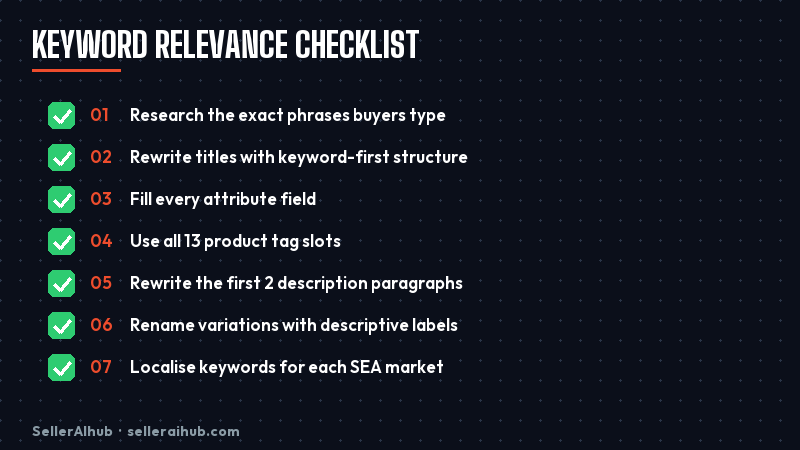
1. Research the Exact Phrases Buyers Type
Open Shopee search, type the first two words of your product category, and screenshot every autocomplete suggestion. Those are real buyer queries — ranked by search volume in your region. Tools like SplitDragon or free Shopee keyword research tools give you search volume and competition data to prioritise further.
2. Rewrite Titles with Keyword-First Structure
Put your highest-volume keyword in the first 30 characters. A strong title template: [Product Type] [Key Attribute] [Brand] [Size/Variant]. Example: “Wireless Earbuds Bluetooth 5.3 Sony WF-C500 True Stereo”. For a deeper breakdown, see our Shopee product title optimization tips for 2026.
3. Fill Every Attribute Field
Open any listing in Seller Centre, click Edit, and scroll to Product Attributes. Any blank field is costing you visibility. Fill them even when Shopee marks them optional — the algorithm still scores them. Use Shopee’s bulk edit tool to update all listings in one go.
4. Use All 13 Product Tag Slots
Mix three tag types: exact synonyms (“phone case”, “mobile case”), attribute combinations (“shockproof iPhone case”), and buyer use-case phrases (“anti-scratch slim cover”). Never duplicate the exact title — tags are for additional coverage.
5. Rewrite the First Two Description Paragraphs
The top of your description carries the most weight. Open with 2–3 sentences that restate the keyword and main use case. Follow with a bullet list of features — Shopee reads bullets as structured content and scores them favourably.
6. Rename Variations with Descriptive Labels
Replace generic variation names (“A”, “B”, “Option 1”) with descriptive ones (“Midnight Black — 500ml”, “Rose Gold — 1L”). This is free relevance signal that most of your competitors leave on the table.
7. Localise for Each SEA Market
If you sell in multiple SEA countries, keywords don’t translate 1:1. Malaysian buyers search “tudung” where Singaporeans search “hijab”. Filipino queries mix English and Tagalog. Audit your top listings per market separately — running the same title across SG/MY/PH/TH/ID leaves real search volume on the table.
Common Mistakes That Tank the Shopee Keyword Relevance Ranking Factor
- Keyword stuffing. Shopee penalises titles that repeat the same keyword 3+ times. Use synonyms and attribute variants instead.
- Leading with brand names buyers don’t search for. Unless you’re Nike or Samsung, the brand belongs after the product type.
- Copy-pasting supplier titles. Supplier-written titles are full of spec codes no buyer types. Rewrite in buyer language.
- Leaving attributes blank because they feel repetitive. They’re scored regardless.
- Using identical tags across 50 listings. Shopee’s de-duplication treats this as spam signal.
Tools to Audit Your Shopee Keyword Relevance Ranking Factor
You don’t need paid tools to start, but they speed up the work substantially:
- Seller Centre Listing Quality Score — free, built-in, shows title/attribute/image completeness per listing.
- Shopee Search Autocomplete — free keyword research by typing and capturing suggestions.
- SplitDragon / Mangools / Ahrefs — paid tools for search volume, competition scoring, and gap analysis across your catalogue.
- Shopee Analytics → Traffic Sources — shows which keywords currently drive clicks to your store, useful for doubling down on what’s working.
Start with the free options. If you manage 100+ SKUs, a paid keyword tool pays for itself within a month through faster audits.
How Long Until Keyword Changes Affect Ranking?
Shopee’s search index typically refreshes within 24–72 hours of a listing edit. Ranking changes follow over the next 7–14 days as the algorithm collects new click and conversion data on the updated listing. If you don’t see movement after two weeks, the issue isn’t keyword relevance — check the 2026 Shopee search algorithm updates for what else might be dragging you down.
FAQ: Shopee Keyword Relevance Ranking Factor
Is keyword relevance the most important Shopee ranking factor?
It’s the most controllable factor. Shopee weighs keyword relevance alongside CIM score, seller metrics, and listing quality. For new and mid-tier sellers without deep review history, fixing keyword relevance usually delivers the fastest visible ranking gains.
How many keywords should a Shopee title contain?
Aim for 2–4 distinct keywords within the 100-character title limit. More than that and Shopee treats the title as stuffed, which hurts both ranking and click-through. Lead with your highest-volume keyword, then layer attributes.
Do product tags really affect keyword relevance?
Yes — especially since Shopee’s 2026 index update made tags a requirement for filtered and tag-based search surfaces. Listings without tags are effectively invisible in those views.
Can I use the same keywords across all listings?
No. Shopee’s de-duplication system flags stores that repeat identical titles and tag sets across catalogue items. Each listing should target a distinct buyer query, even for product variants.
Does AI-generated content hurt the Shopee keyword relevance ranking factor?
No — Shopee doesn’t detect or penalise AI-generated text. What matters is whether the content is specific, accurate, and buyer-relevant. An AI-written title with the right keywords outperforms a human-written one that’s vague. See our guide on how to write Shopee product descriptions with AI.
Next Steps
The Shopee keyword relevance ranking factor isn’t a one-time fix — it’s an ongoing optimisation loop. Start with your top 20 listings by impression count, rewrite titles and fill attributes, and check ranking movement every two weeks. Once the highest-traffic listings are clean, work down the catalogue.
For the full picture of how this one factor fits alongside the other six ranking signals Shopee uses, read our complete guide to how to rank higher on Shopee search in 2026.
💬 Join the Discussion
Got a question or seller tip? Drop a comment below.