
Running an ecommerce store in 2026 without AI tools means competing against sellers who write listings in seconds, respond to customers around the clock, and optimise ads automatically. The best AI tools for ecommerce sellers in 2026 aren’t about replacing your judgment — they’re about removing the repetitive work so you can focus on what actually grows your store.
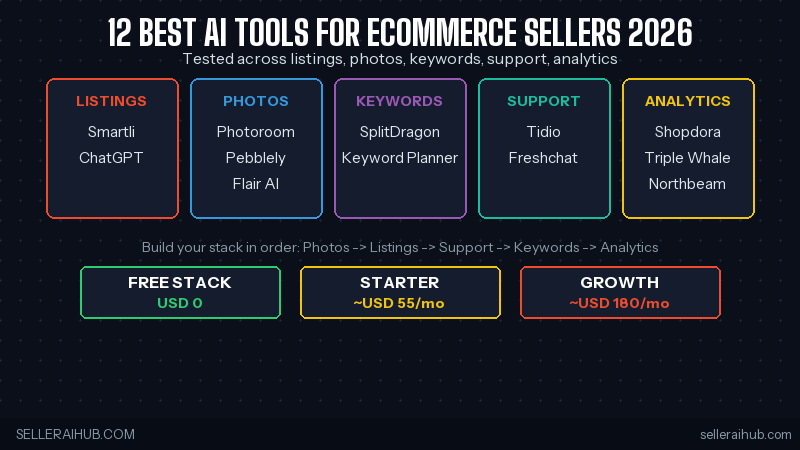
Quick Answer: The 12 best AI tools for ecommerce sellers in 2026 cover five categories: listing creation (Smartli, ChatGPT), product photos (Photoroom, Pebblely, Flair AI), keyword research (SplitDragon, Google Keyword Planner), customer service (Tidio, Freshchat), and store analytics (Shopdora, Triplewhale, Northbeam). Start with photos and listings — they deliver the fastest ROI.
Why Ecommerce Sellers Need AI Tools in 2026
The average ecommerce seller managing 50+ SKUs spends 15–20 hours per week on tasks that AI can handle: writing product descriptions, answering repetitive customer questions, editing product photos, and analysing which listings underperform. AI tools don’t just save time — they reduce the skill ceiling. A solo seller with the right tools can produce catalogue content and ad creative that previously required a small team.
Best AI Tools for Ecommerce Sellers 2026 — Full List
| Tool | Category | Best For | Free Tier | Starting Price |
|---|---|---|---|---|
| Smartli | Listing creation | Marketplace listing copy (Shopee, Lazada, Amazon) | Trial only | ~USD 18/mo |
| ChatGPT (GPT-4o) | Listing creation | Custom, flexible product copy | Yes (limited) | USD 20/mo |
| Photoroom | Product photos | Background removal + studio backgrounds | Yes | USD 9.99/mo |
| Pebblely | Product photos | AI lifestyle backgrounds, batch processing | Yes (40 images) | USD 19/mo |
| Flair AI | Product photos | Scene staging for branded product shoots | Yes (10 credits) | USD 10/mo |
| SplitDragon | Keyword research | Shopee and Lazada keyword data for SEA | Yes (10/day) | ~USD 15/mo |
| Google Keyword Planner | Keyword research | Broad keyword research, free | Yes (free) | Free |
| Tidio | Customer service | AI chatbot + live chat, multi-channel | Yes | USD 29/mo |
| Freshchat | Customer service | AI bot with CRM integration | Yes (limited) | USD 19/mo |
| Shopdora | Analytics | Shopee ranking and competitor analytics | Trial only | USD 22/mo |
| Triple Whale | Analytics | Multi-channel ad attribution (Shopify-first) | No | USD 129/mo |
| Northbeam | Analytics | Cross-channel attribution for scaling brands | No | USD 250/mo |
Category Breakdown: Which AI Tools to Start With
1. AI Listing Creation Tools
Smartli is the fastest path to marketplace-ready product titles and descriptions. It’s built for online marketplaces — character limits, keyword conventions, and attribute formatting are all handled automatically. ChatGPT is the more flexible option: it can write for any platform, match any tone, and handle complex or technical products, but it requires more detailed prompting to produce marketplace-optimised output. Use Smartli for volume, ChatGPT for complex or brand-heavy listings.
2. AI Product Photo Tools
Photoroom is the most widely used AI photo tool among marketplace sellers — its background removal is fast and accurate, and its studio background library covers most standard ecommerce styles. Pebblely specialises in AI lifestyle scenes: upload a product image and it generates contextual backgrounds (kitchen, office, outdoor) that require no photography equipment. Flair AI is for sellers who want full creative control — you can design the scene, lighting, and props entirely within the tool. Start with Photoroom for clean backgrounds, upgrade to Pebblely or Flair when you need lifestyle imagery.
3. AI Keyword Research Tools
SplitDragon is purpose-built for Shopee and Lazada keyword data — it shows search volume and competition scores from the marketplace itself, not Google estimates. For sellers on Shopify, Amazon, or other platforms, Google Keyword Planner remains the best free starting point for identifying demand. For the most complete SEO picture, pair a marketplace-specific tool with Google data: they catch different search intent patterns.
4. AI Customer Service Tools
Tidio is the most polished AI chatbot for ecommerce sellers — its Lyro AI engine handles up to 70% of customer queries without human input, and it integrates with most major ecommerce platforms. Freshchat is the better choice for teams that already use Freshworks’ CRM suite. Both tools offer free tiers that cover basic use cases. For sellers primarily on Shopee or Lazada, Duoke’s native marketplace integration is worth considering over either of these.
5. AI Analytics Tools
Shopdora is built specifically for Shopee analytics — keyword ranking tracking, competitor monitoring, and listing performance scores. For Shopify-based brands running paid social, Triple Whale and Northbeam provide cross-channel attribution that Facebook’s native analytics can’t match. Shopdora is the right call for marketplace-first sellers; Triple Whale and Northbeam suit D2C brands spending USD 10k+ per month on ads.
Recommended AI Tool Stacks by Budget
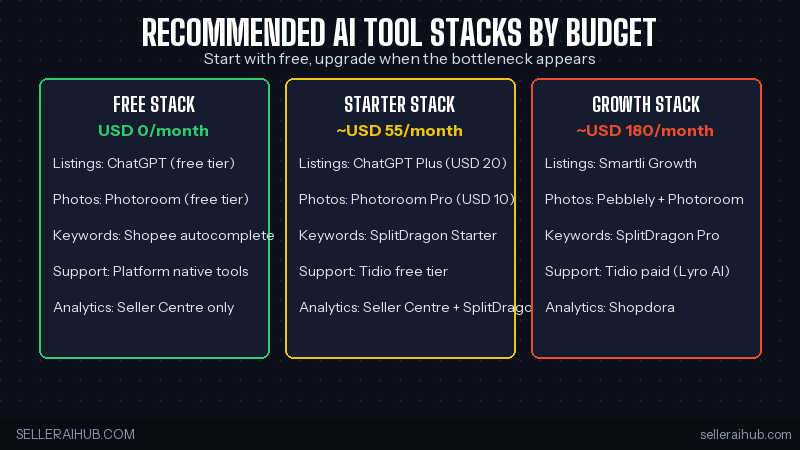
| Budget | Listing | Photos | Keywords | Customer Service | Monthly Cost |
|---|---|---|---|---|---|
| Free | ChatGPT (free) | Photoroom (free tier) | Google Keyword Planner | Platform native | USD 0 |
| Starter (USD 50–80/mo) | ChatGPT Plus | Photoroom Pro | SplitDragon Starter | Tidio (free tier) | ~USD 55/mo |
| Growth (USD 150–200/mo) | Smartli Growth | Pebblely + Photoroom | SplitDragon Pro | Tidio paid | ~USD 180/mo |
Best AI Tools for Ecommerce Sellers 2026 — FAQ
What is the best free AI tool for ecommerce sellers?
ChatGPT’s free tier (GPT-3.5) is the most versatile free AI tool for ecommerce — it handles listing copy, customer reply templates, ad copy, and product descriptions. For product photos, Photoroom’s free tier removes backgrounds without a watermark for a limited number of images per month. Combine both and you have a capable zero-cost AI stack for new sellers.
Do AI listing tools improve search rankings?
Indirectly. AI listing tools produce keyword-rich, well-structured titles and descriptions faster than manual writing. Better-structured listings score higher on quality metrics (like Shopee’s Listing Quality Score), which feeds into ranking. The AI doesn’t guarantee rankings on its own — the keywords chosen and the listing’s click-through and conversion rates still determine position.
Can I use the same AI tool stack for Shopee, Lazada, and Shopify?
For most categories, yes. ChatGPT, Photoroom, Pebblely, and Tidio work across all platforms. SplitDragon is marketplace-specific (Shopee/Lazada). Shopdora is Shopee-only. If you sell across all three platforms, build your core stack from cross-platform tools and add marketplace-specific tools where the data quality justifies the cost.
How long before AI tools produce a measurable ROI?
Product photo tools typically show ROI within the first week — better images lift click-through rates immediately. Listing copy tools show ROI within 2–4 weeks as rankings adjust. Customer service tools show ROI within the first month through reduced manual chat time. Analytics tools take 4–8 weeks to produce actionable data patterns.
Conclusion: Build Your Stack in Order
The best AI tools for ecommerce sellers in 2026 work best when added in order of impact: start with photos (fastest ROI), then listing copy (ranking lift), then customer service automation (time saving), then keyword research (strategic), then analytics (scaling). Don’t buy everything at once — pick one tool per category, use it for 30 days, then decide whether to upgrade or switch.
For sellers on Shopee specifically, see: Best AI Tools for Shopee Sellers 2026 — it covers platform-native tools and SEA-specific options not listed here.
💬 Join the Discussion
Got a question or seller tip? Drop a comment below.